Thursday, March 24, 2011

Big ol'


Something that keeps coming up as a running joke in my compound is how "wide" I am. "Fanta be warima...pip!" (Fanta is wide....Very!) gets echoed to me at least once a day. Somehow, to my dismay, this became a running joke in my host family. I'm not that wide, I'm about normal adult Gambian woman sized. I wear pants which might show it off a bit more but really, does that mean its time to call Fanta a fatty every 5 minutes? This got me thinking about body image, and Gambian's thoughts on women's bodies, specifically size.

Before I lived in Gambia I thought Africa was the place that big women were queen. Statues I remember seeing never showed women with jutting collar bones but women with hips 3 times the width of their waist. Popular media led me to believe that African's didn't want a lean feather of a women but someone who could show off, through their voluptuous, that they were well off economically, healthy enough to bare children, and had a little extra in case times got tough with food.

I am often told I am big. This doesn't overly get to me since Gambia has made my skin thick but its interesting that they love this running joke. It's almost more of a compliment. A big ass seems to be on everyones mind when it comes to the erotic. Though women don't show their legs they never say "oh your legs are thick, thats nice!", but I do here "your ass is wide, your husband must be a happy man".

When asking my host mom about this she said "big is ok but too big isn't. When it gets hot, all those women say is "uh, ooo uh, this heat" and they sweat SO much". Big is ok but small is better. I have heard Gambian men say "I know some guys like bigger ladies, but I want someone small, petite, not a huge woman." Most Gambian women aren't small. They aren't huge either but one a woman has a child you rarely find tiny women. Most are made of muscle, and though they aren't fat at all, they aren't petite.

Most teenage girls are TINY and I think the ones that are a little chubby are treated the same way teen girls are treated in America. Some people are terrible attractive even if they are bigger and some tiny women aren't inherently attractive because of their size.

There is a compound in my village with two obese women. Their husband is a small man but he definitely has a type of woman he likes. In an attempt to get my host family to see me as a normal size woman I made a joke about that other compound, instead of being called Fofana Kunda (the last name is Fofana) it should be called Wide Kunda. My family loved it, but now they just tell me that I'm getting so big I will have to go live there. I can't win with this joke. They somehow know that western women tend to like to be small so any time I go running they say "Fanta wants to be small. She doesn't like being big". I think they hold me to a American standard and themselves to their own. At least my host mom is hugely pregnant right now, so all the teasing can be given in return.


This is the mosque in my village. Right after this picture they started to paint it white.


These kids are dressed up at Kangkorans. Their outfits aren't that good, but notice the weaponry.


Thought I did not plant Tomato in my garden the rouge Tomato and Okra plants cuddled up to my Bell Pepper and Cabbage are the first things to produce anything. This tomato si the first thing out of my beds.


The Corn is corn left over from the last rainy season. It's hard as hell and the family works the kernels to free them so later they can be pounded.


This is my bed set up outside. It's MUCH better outside.


The next three shots are of my hut. It's not always this dark but since it was in the evening it looks it.

Saturday, February 26, 2011

I want you

In one of my late night talks with my host mom I finally started to get some romantic details from her. Of everyone I know she is my closest Gambian friend and is amazing at understanding my Mandinka. She seems the best to eventually get all the real details of a Gambian woman’s life. I’m starting slowly but like any little kid hearing how their parents met, I was interested in the littlest detail.

We originally started talking about girlfriends and boyfriends. I asked if my host dad was her boyfriend before he was her husband. She said, “Fanta, black people and white people are not the same. You white people have boyfriends or girlfriends, we don’t. Here, that is not good”. I asked if she had ever had a boyfriend and she said basically repeated what she said before. I asked if her and Dikori just starting talking, hit it off, and decided to get hitched. She said “No, I went to Bansang, he saw me and asked if I had a husband. I said no and he said he liked/wanted me. I told him that we are Gambian, if he wants me he needs to go talk to my parents.” I asked if she was originally annoyed that this man was talking to her like this. I have to wave my hand to men in car parks and on the street to make them leave me alone often and it gets irritating. Maybe the difference is that Gambian women have a split second to make a possibly lifelong choice. This man presents an opportunity and the woman will eventually say yes to one of them. Bana said he went to her mom’s place, talked with her family, and eventually he was allowed to “buy her”. Eventually she came to live in his compound.

I had heard that women don’t really get to sleep for 3 days before their wedding. She said “yeah, people are coming all the time and you are busy and just never get to sleep”. After a woman is brought to her husband’s house she had to stay in her house for a week. She is only allowed to go to the backyard and the rest of the time she is in her room. Weddings are always in the hot season and in the afternoons rooms can be terribly hot. She said “oh, it's so hot in there, and you have to stay in there. It’s not sweet.” I told her that some people in Kombo have boyfriends or girlfriends but I guess no one really has one in my village since our village is so conservative. She said “they are here, but people don’t want others to know. At night they go out and hang out with them. It’s not good but it happens and people keep it a secret.”

I got to tell her that most Americans date first. We want to make sure we find someone that we can get along with, someone we can enjoy things with, and that we always worry about divorce so we want to pick the right person. She seemed to understand but I don’t think she was sold on the idea. The good thing about her is that though she doesn’t always agree with the American way of life she never treats me negatively for personifying some of the American behaviors she doesn’t like. She is really tolerant of things she doesn’t support.

Villager Profile

Name: Bana

Age: Roughly 27

Education: some lower basic school

Children: 1 rather difficult 2 year old and one hopefully good baby on the way.

Job: School Committee and Women’s group member.

Hobbies: Sewing, braiding hair, sleeping (mostly during pregnancy), gardening, drinking tea.

Best quote: “Fanta is BIG! Fanta be GREAT!” (in English!)

Thursday, February 24, 2011

"Thinking is not good"


My favorite part of each day in village is the evening and night time. Around 5 o’clock all yelling children go back to their respective homes, the women go to the garden, and I am left with the compound to myself for a minute. Things suddenly quiet down, the sun is starting to get at a beautiful angle, and I can pick up my house and relax. I love this time because there is no pressure to be out with my family. For about 2 hours I can do whatever I want. Normally I sweep my place, pick things up, wash dishes, listen to music, take a shower, have a snack. It’s all small stuff but I like not feeling expectation on me from people in my village.

As its starting to get dark I leave my house and sit next to my host grandma on the bantiba. Her and me aren’t big chatters to each other but we share a mutual affect for one another. She is the cutest old woman around and has always been really sweet to me. I always take her advice because I don’t think she has any malicious intentions ever and especially towards me. Her garden prowess is probably the only thing keeping my black thumb from destroying all of Gambia’s ecosystem.

Eventually everyone comes back to the compound and settles on the two bantibas. One of my two host moms will be working on the koos dinner (not anything like coos coos, don’t envision something amazing or anything) and everyone else will be laying out and talking. This is normally the time that the girls in my compound come to me for homework help. Normally it’s math or reading practise. My host sister in grade 4 is really starting to pick up sounding words out. I know that sounds silly that a 4th grader is just starting to sound stuff out but for here, thats not bad.

Shortly after dark we eat dinner. My grandma and I each have our own bowl of Koos and the family shares a large bowl of it. I like koos. It looks like sand and sometimes is a bit flavorless but sometimes the sauce can be almost good and its enjoyable.

Then I star gaze, sometimes talk with my family, and eventually am asked why I am being so quite. I told my host grandma about a list of things I was thinking over and she said “you are being quiet and just thinking, that’s not good”.

If my host dad comes home early enough and eats his dinner he always invites me to eat from it. It’s half mandatory but it’s a good time to talk to him. I don’t really see him otherwise since he is a geli driver and works from 7am to about 8pm.

The other night my host family was listening to Jeliba (Gambias biggest musician. If you don’t know who he is Gambians will say “He went over to America! You don’t know him!?”). Suddenly one of the neighbour kids hooped up and started dancing. It was dancing like what you would see a Kangkoran do at a wedding party. It would go from slow, to quick leg movements, then posed, then butt shaking. This lasted for a good 30 minutes. Any time the song picked up pace this kid would jump up and start stealing the show. I used my flashlight to give him a spotlight and everyone got a kick out of this kid. Even now they still bring it up, “remember when Adama was dancing? Man! That kid can dance!”.

As always, here are some pictures.

The first is a picture of a Kangkoran. This one is the fun party type that show up for festivals. It's not actually a Kangkoran, its a Devil. This was the New Years Devil.


This is a Bitik. Its a littleshop that has a a ton of little things you could want. Cookies, Batteries, Bread, Soap. They are really useful and every village has them


This is a power outlet at the old PC house. Safety is our top priority. Don't Touch signs were all over the place.


This is my host dad holding up some Obama Attaya. If Obama got royalties from the stuff that his face sells he would have even more money. Seriously, there is tea, motor oil, shirts, belts, hats, stickers. Obama all over the place.


Lunch is up! Green leaf sauce that most don't like. I like it and rather prefer it to the oily sauces we have. It's okra, cassava leaf, some other leaves, and dried fish.


This is the garden that my family grows their food in. Most of it is onion and red pepper. I have 2 beds of my own that have green bell pepper and cabbage. My cabbage is quickly being eaten by bugs but I still have hope. My host grandmother said "cabbage work is not sweet" and I am starting to agree. My peppers are coming along nicely though everyone swears they will be the long green spicy peppers. Lets hope not. To get our there I have to either walk through leech laden thigh deep water or a 50 feet swamp walk. I choose the quicker thigh deep water.


This a Momalamin and Satang. Momo is 3 and Satang is about 11. They are both pretty fun. The expression of the 3 year old was pretty funny.


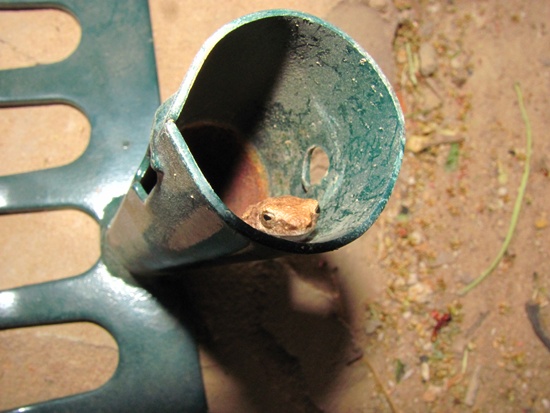
This is a little guy I saw in my rake. It was during the rainy season and my yard was taken over by frogs at night. I still get them there now that sit in the puddles from my laundry and dish washing. Since I live by a swamp the night echoes with hundreds of frogs.

Wednesday, January 5, 2011

All the oranges in this country are yellow

PC isn’t a vacation. A lot of people think we get paid to live in a foreign country while we sit back, drink tea, and enjoy the exotic cuisine (or sometimes not enjoy the exotic cuisine). That happens, but the rest of the time we are actually trying to get work done.

If at times we seem sedentary, it’s not because we want to be, it’s because our counter parts ran off to a naming ceremony, or the committee can’t meet because they are harvesting peanuts, or everyone in the office that you need to talk to has gone to the capital for a 3 week training. Besides, I can’t learn Mandinka by never socializing.

So, what do I do?

My primary job is working with a Nursery School to develop its infrastructure, work on teacher development, sensitize the community towards education, and make sure the school and all its little parts are working within the bureaucratic structure of Gambia. I’m basically an accidental education volunteer. The work sounds fancy and all, but there is nothing fancy about grass roots work.

I mostly work with the school committee to get things done, meet with the teachers to try to get them on board with fulfilling their contracts and work on their teaching skills, and bounce from building to building trying to get papers signed often while being told a list of several more hoops to jump to get my task done. An example of this is how I have tried to get my school’s committee registered for basically the last 9 months.

Working with the committee has been one of the single most frustrating parts of my service (besides cross country travel, trying to rescue birds that are “pets”, and getting called Toubob every other minute on a bike ride). There is a silver lining though, because with each encounter, both pro and con, I learn a little bit more about the culture and the people in my village. I don’t think my committee can be used as an example of all Gambia groups, at least I hope not, but I’m still learning from it anyways.

The main reason for writing this blog is to tell a little story of a sign. It’s a bit taller than me, white, and says “Kanubeh Nursery School” in the colors of Gambia. It was purchased by 3 of the 5 people from the NGO Gambia Up-Country Development when they visited about a month ago. The NGO are the funders for the nursery school. For safe keeping I put it in my backyard after they left and I was given the task of following up with the Planning Department to make sure we can legally put it up.

I went to the Planning Department ready to take a piece of paper from place to place to get signed and approved. To my surprise they had already taken it for me and just needed to put one more stamp on it, which they did right away. It was good to go! I didn’t have to do anything! The sign could go up right away. A Christmas miracle really.

When I got back to my village I jumped out of the geli just a couple feet from the Chairman of the School Committee. I don’t know the word for sign, bury, or put in the ground but luckily there was an English speaking guy (1 of maybe 5 in my village) close by and I had him tell the Chairman we could put the sign up this week, hopefully before the heads of the NGO come next week (at the date of publication, today). I knew things weren’t going well when the Chairman said a paragraphs worth of speech, starting low and eventually talking forcefully while wagging his finger. There was a pause before my translator said “you know, he says the committee was not informed about the sign, and to ask them for the labor, people are working in the fields, and they do not want to do it because they were never told about it”. I thought “They were given this sign (expensive) and now they won’t put it up. Seriously people!?”. I said “ok...ok...uh, ok” and walked away. But later I thought “Wait, they were informed of it, invited to come paint it, and some members showed up to drink tea and paint.” I asked the Chairman’s brother to talk to him.

I met up with the Chairman’s brother and he said “I haven’t talked to him, but the committee is upset, they were invited over there and then one of you told them to go to the school to see something. They were invited then pushed out. They are not happy”. Remembering this occasion I think we started the 3 rounds of tea (because any good social event HAS to have tea), around the beginning of round 2 the sign was done, we told them it was done and didn’t have to stay. Possibly we went to the school to work on something. I don’t honestly remember how it went down. But this brings up something I constantly experience here. An example is the word in Mandinka for the color orange and yellow. It’s the same word but one is the darker version of the other. To an American they are different colors, to a Mandinkan they are the same. With this sign incident the NGO and PCV’s saw the sign painting as over and didn’t want to waste the committee member’s time. With the sign incident the Committee saw that they were invited over, tea was brewing and that they were shoo’d away prematurely.

So now, to show their frustration they are refusing to put the sign up. The heads of the NGO are coming tomorrow and the sign is still in my backyard. What type of image are they going to be showing about their commitment to the school if they won’t even put up a sign? But, they would rather cut off their nose to spite their face. And culturally, there isn’t really a right or wrong. The westerners feel they are right, the Gambians feel they are right. It’s the same situation but the way we see it is completely different. This type of problem comes up far more often that I can count. In the end, all I can do is ignore the crap and press on.

I’m sure when the NGO comes the committee will say they were never informed, then will say they were informed but we treated badly, then eventually things will get smoothed out and the sign will go up. Part of my job is doing work while constantly taking culture into consideration. My village just happens to be far more sensitive than the average Gambian on certain issues. I’m the minority here and nothing works how I think it will. It’s frustrating but in my extremely conservative, uneducated (for now but not ever!), slow paced village that’s how it’s going to go.

This won’t be the sign that broke the donkey’s back.


And as always, here are some random pictures from my random life.


The Gang doing a Gambian style photo op. My host brothers makings spoons out of some melon, a host brother cutting hair, us trying to dance in the Dink style, the ballon drop, kids trying to knock down Baobob out of the trees, and the wrapper of some fireworks. All of the shinanigans are from New Years in Basse with my fellow PCVs and the VSO Brits.


Saturday, January 1, 2011

50+20=100

There is a change going on up here. It’s slow, and frustrating, and uncertain but I see the beginnings of something that will take years and years to become something tangible.

50-50. This is the phrase you hear when people talk about women’s rights. It was supposed to be about work load and benefits between a man and (a) woman (en) within a marriage but now it seems to be used as a umbrella term for equality.

When you talk with women about 50-50 they seem in support. They think that in America and the West women live happy lives and their husbands help them with tasks and everyone works equally. In some ways that is true though probably not to extent of their day dreams. When you talk to men about 50-50 they usually laugh with a shake of the head “ha, oh 50-50, Do you guys really have that there? Ha, that’s crazy”.

Some people seem torn on the issue. From my host father I have heard “50-50, I think 50-20.” When I heard this I thought, “Is he trying to be clever because he has two wives?” But after half a second I realized “50+20+20≠100”. He isn’t about equality within his marriage in any way. He is the ruler of his compound, he wants his water carried for him, wants his dinner brought to his feet after his shower, and expects his wives to do a quick kneel to him every night. If he is thirsty they have to bring water to him even if they are far away from the water and he is next to it. If anyone is going to get beat in the compound it certainly isn’t him.

I have heard him discuss with other men about the new policy about that if a man beats his wife she is to take him to the police. I’m sure he isn’t pro about this since I have the host family that always fights during the holidays and if that law was being acted out he would have spent Koriteh and Tobaski in jail.

But then, this same man (who treats me very nicely) will say “I want all of my children to go to school. My sons and daughters... maybe Fatou Mata can be a doctor, or a pilot. Yes, I never got to go to school, but I want my children to go.” That is a VERY progressive stand compared to most of Gambia.

Recently the Vice President (“Her Excellency), along with Tostan (a huge NGO that does just about everything), and the Women’s Coalition made a trek up to the URR to do a march and hold multiple meetings about equality in Gambia. There was a radio presentation that preceded the arrival of “Her Excellency” that reached a majority of URR households and though some scoffed, some listened with quiet excitement, and some were indifferent it started the discussion about women’s rights.

My host mom’s live in an extremely conservative village. They have told me they can’t wear nail polish, no upper calves showing, no pants, hair is always covered, ect. As an example, they once were concerned that my “husband” would be upset about a picture with me and some musicians because I was sitting next to them. One time they were asking me if people lived in large family units in American or on our own. I explained that after 18 we are expected to eventually move out, get a job, and start to support ourselves. I said “everyone works. Women and men.” They both nodded and said “A betiyatta (it’s good)”. I could see why a Gambian couple moving to America would have problems. I think the change for the woman might come more naturally with some culturally supported freedoms and the man of the relationship might feel a lose of control in a situation in which he used to have total authority.

This is not representative of all relationships though. Recently while talking to a volunteer’s former host dad he told me “Love is easy, you work together, you talk to each other, we both watch the children, you support each other”. Some people are naturally a great example that not everyone is in a power struggle of a relationship.

Gambia is a place in transition. It is a country with a woman Vice President and women wearing burkas in the streets.